

The AI Traffic Your Analytics Can't See
Short answer: A large and fast-growing share of the traffic to your content now comes from AI: crawlers training models, bots fetching pages to cite in AI answers, and agents acting on behalf of users. Almost none of it shows up in tools like Google Analytics, because those tools run on JavaScript that bots don't execute. The visits are real, and they hit your server. Your dashboard simply isn't built to record them. To see this traffic, you have to measure it where every request actually lands: at the server.
If you run a content site and your analytics feel like they've gone quiet while AI feels like it's everywhere, this is why. Let's walk through it.
What is "invisible" AI traffic?
Invisible AI traffic is the automated, AI-driven access to your content that never appears in your conventional analytics. It comes in a few distinct forms, including crawlers that harvest your pages to train models, bots that fetch your content to cite it in live AI answers, scrapers that extract it wholesale, and AI agents that browse on a user's behalf. They have different motives, but they share one trait: they consume your content without registering as visitors in the tools you use to understand your audience.
It is, for most publishers, the single fastest-growing category of access to their content, and the only one their dashboards can't show them.
Why your analytics can't see it
This isn't a setting you forgot to switch on. It's structural, and it comes down to how conventional web analytics work.
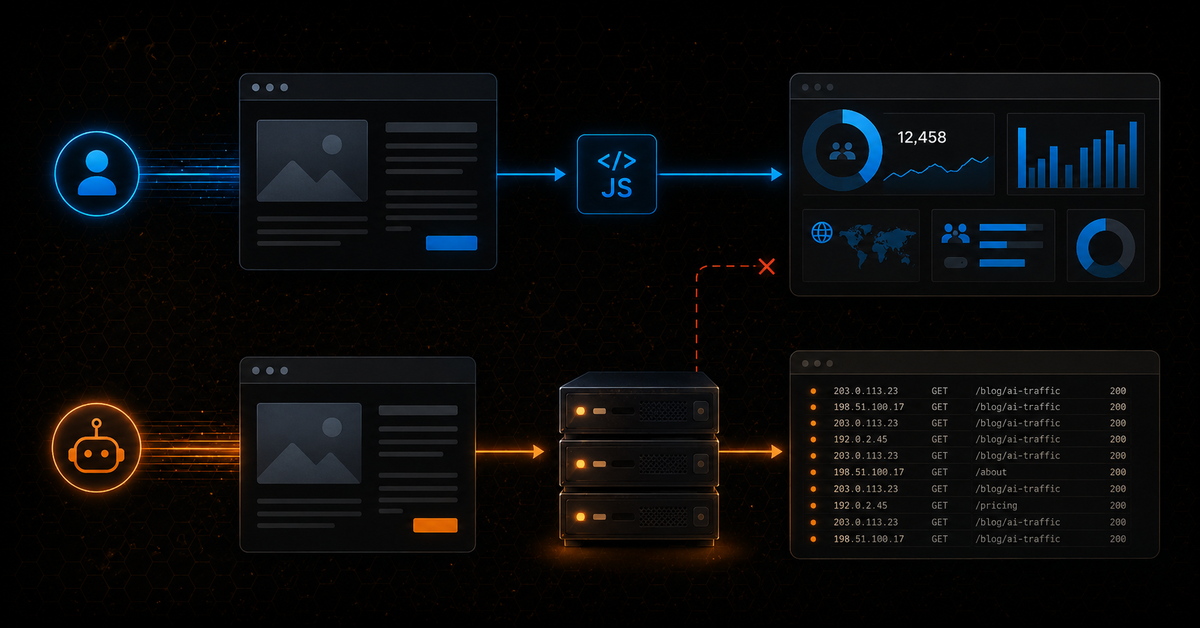
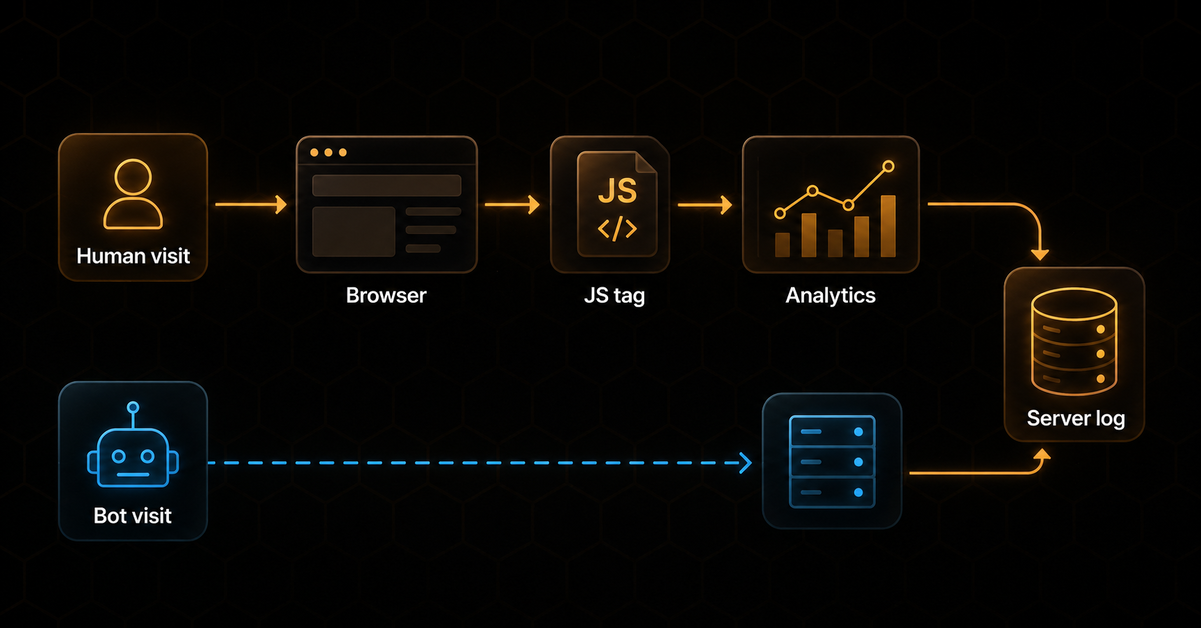
Tools like Google Analytics (GA4), Adobe Analytics, and most product analytics are client-side. They work by embedding a small JavaScript tag in your pages. When a real person opens a page in a browser, the browser loads and runs that script, which pings the analytics service and records the visit, the page, the referrer, and so on.
Bots, for the most part, don't run JavaScript. A crawler or scraper requests the raw HTML of your page and reads it directly. It never executes your tracking script, so the script never fires, so the visit is never counted. From your analytics' point of view, that visit simply didn't happen.
Then it gets worse: analytics platforms also deliberately filter out known bots to keep human metrics clean. So even the well-identified crawlers that could be counted are excluded by design.
The result is a blind spot you can't configure away. Here's the same page request, seen two ways:
| Human visitor (browser) | AI crawler / bot | |
|---|---|---|
| Requests your page | Yes | Yes |
| Runs your page's JavaScript | Yes | Usually no |
| Fires your analytics tag | Yes → recorded | No → nothing fires |
| Appears in Google Analytics | Yes | No (and often filtered out) |
| Appears in your server logs | Yes | Yes |
Notice the last row. There is one place every request lands no matter what (human or bot, JavaScript or not, counted or filtered): your server logs. Every single hit to your origin leaves a line there. That's where the full picture lives. The catch is that raw logs are enormous, noisy, and tedious, which is exactly why almost nobody reads them, and why the AI traffic inside them stays invisible in practice even though it's technically recorded.
What's hiding in that traffic?
Lumping it all together as "bots" hides the part that matters: these visitors want very different things from you. Broadly:
- Training crawlers harvest your content to train AI models (identifiers like GPTBot, ClaudeBot, Google-Extended). They take; they give nothing back.
- Search and answer crawlers fetch your pages to cite them in live AI answers (identifiers like OAI-SearchBot, PerplexityBot). These can send readers your way when they link.
- Scrapers extract content in bulk, sometimes disguised as ordinary traffic and sometimes ignoring the rules entirely.
- AI agents browse and act on behalf of a user, and can look almost identical to a human visitor.
The difference between an extractive training crawler and a referring answer crawler is the difference between a cost and a channel, and you can't tell them apart without seeing them. (We break down the full taxonomy in crawler vs. scraper vs. agent.)
Why this matters for publishers
It's tempting to file this under "technical curiosity." It isn't. The invisible layer is where some of the most consequential shifts in the content business are now happening.
The old bargain is breaking. For two decades, search engines crawled your content and sent readers back in return as traffic you could monetize. AI increasingly consumes your content to answer the question directly, and often sends no one back at all. Your work still powers the answer; the visit just never arrives.
It's both a cost and an opportunity. This traffic loads your servers and feeds products that compete for the same attention you do. But it's also the basis of a fast-growing licensing market, and the answer crawlers are becoming a genuine discovery channel. Which side of the ledger it falls on depends entirely on which bots are doing what.
Every option requires visibility first. Whether you want to block extractive crawlers, charge for access, negotiate a licensing deal, or lean into AI citations, you cannot make any of those moves intelligently without knowing who is taking what. You can't price, defend, or monetize what you can't measure. Visibility isn't the strategy, but it's the precondition for every strategy.
How to actually see it
Since the traffic lives in your server logs and nowhere else reliable, that's where you have to measure it. The challenge is purely practical: logs are too large and too raw to read by hand, and the bots that matter most are scattered across millions of lines and constantly changing identities as new crawlers appear.
What you need is something that reads those logs continuously, identifies and classifies the AI traffic inside them in real time, and works regardless of which CDN or security stack you run. This matters because the measurement has to be independent of the tools that are blocking or routing the traffic. That's precisely the problem HoneyLog is built to solve: it turns the one complete record you already have (your server logs) into a continuous, readable view of every AI bot reaching your content, even at very high volume.
What you can do once you can see it
Visibility opens up the decisions that were impossible while you were blind:
- Block the crawlers that purely extract.
- Charge the ones willing to pay for access.
- Negotiate a licensing deal with the companies taking the most, backed by your own evidence.
- Allow the answer crawlers that cite and refer readers back to you.
That decision space is the subject of our block, negotiate, or monetize framework. And if you're relying on an edge tool to handle all this for you, it's worth understanding what that does and doesn't cover. See HoneyLog vs. Cloudflare and why blocking by default isn't the same as measuring.
The first step is the same for everyone, though: stop flying blind. The traffic is already there, already recorded, already shaping your business. The only question is whether you can see it.
Frequently asked questions
Why don't AI bots show up in Google Analytics?
Because Google Analytics is client-side: it relies on JavaScript that runs in a browser, and most bots don't execute JavaScript, so the tracking tag never fires. Analytics platforms also filter out known bots by design. The visits still reach your server, but they just never reach your dashboard.
What counts as AI traffic?
Automated, AI-driven access to your content: model-training crawlers, search and answer crawlers that cite you in AI responses, bulk scrapers, and AI agents browsing on a user's behalf.
Where can I see AI bot traffic if not in my analytics?
In your server logs. Every request to your origin is recorded there, including the bots your analytics misses. The difficulty is that raw logs are too large and noisy to read manually, which is why this traffic stays invisible in practice without a tool to surface it.
How much of my traffic is AI?
It varies by site, but AI-related bot activity has grown several-fold over the past year and is now a large share of access for many content sites. The honest answer is that you can't know your own number without measuring it at the server level.
Is AI bot traffic bad?
It's mixed. Some crawlers purely extract your content; others cite you and send readers back. The point of measuring is to tell the two apart so you can keep the valuable ones and act on the rest.
Related reading:
Last updated: June 2026. AI traffic is changing fast; we keep this primer current as the landscape shifts.