
What Your AI Traffic Data Is Worth in a Licensing Negotiation
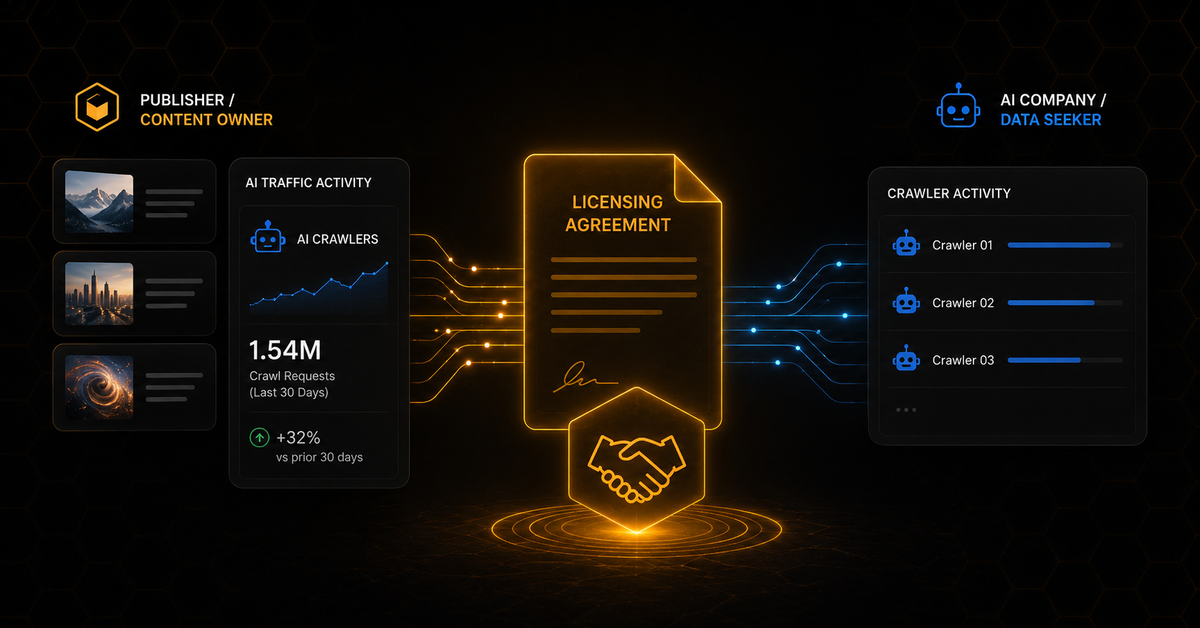
Short answer: Publishers are signing licensing deals with AI companies at an accelerating pace, but the company across the table knows exactly what it took from you, and most publishers walk in with no idea. That asymmetry is the whole game. Your AI traffic data (which crawlers took what, how much, and how it's trending) turns a vague grievance into a priced asset, tells you which AI company depends on you most, and shapes the deal structure in your favor. Without it, you're negotiating blind against a counterparty that isn't.
If you sit on the revenue side of a publishing business, this is the asset you may not realize you already own.
The deal wave is now infrastructure, not experimentation
What started as a handful of headline agreements has become a market. AI content licensing has gone from essentially zero deals a few years ago to dozens annually, and it keeps accelerating. OpenAI alone has signed agreements with a long roster of major publishers, including News Corp, The Atlantic, Vox Media, Axel Springer, the Financial Times, Dotdash Meredith, Le Monde, the Associated Press and more, and Google, Meta, Microsoft, Amazon, Mistral and others are all now active. Reported deal values run from offers in the low single-digit millions to multi-year arrangements worth up to a reported $250 million. (Digiday and Press Gazette both maintain running trackers.)
Two things are worth noting before you assume this is a story about giants only.
First, the leverage is broader than the headlines. Even the biggest publishers hold only single-digit deal counts, and a long tail of smaller publishers is collectively signing a large share of agreements. That fragmentation suggests AI companies are spreading their content sourcing widely, which means mid-size and niche publishers may have more monetizable leverage than they think.
Second, nobody is mailing that leverage to you. The marquee deals were proactive on the AI companies' side because those publishers were too big to ignore. Everyone else has to make the case themselves. And making a case requires evidence.
The asymmetry problem
Here is the uncomfortable structural fact of any AI licensing negotiation: the other side has the data and you usually don't.
The AI company knows precisely what it crawled from you. It has your content in its systems and its own logs of every fetch. When you sit down to value that access, you're the only party in the room who can't see the thing being valued. You're left arguing from a feeling, "you're using our content," while they negotiate from a spreadsheet.
That's a weak position, and it's entirely avoidable. The same activity the AI company logged on its side also hit your servers and was recorded in your logs. The information exists on your side of the wall too. Most publishers just never read it. Surfacing it is what levels the table.
What your data actually does at the table
Closing the asymmetry isn't only about defense. Once you can see your AI traffic clearly, it does four concrete things in a negotiation.
It sets the anchor. Negotiation is anchoring, and "you're using our content" anchors nothing. "Your crawlers made N requests across our highest-value sections over the last twelve months, up X% year on year, concentrated in the content that took us the most to produce" is a number, and a number you set first becomes the reference point everything else is measured against.
It tells you who needs you most. Your data shows which AI companies are crawling you hardest and most consistently. That tells you where your leverage is highest and who to approach first. You negotiate from strength with the company most dependent on your content, not the one that happens to call.
It separates value you should price differently. Training access and live answer-engine access are not the same product. A training crawler harvesting your archive is one kind of value; a search crawler citing today's article in an AI answer is another. Seeing which is which lets you price them separately rather than signing one flat fee that lumps everything together.
It shapes the deal structure. Flat fee, per-use, or tiered, the structure that favors you depends on your actual consumption patterns. If usage is heavy and growing, a per-use or escalating structure may beat a flat fee that locks in today's volume at tomorrow's scale. You can only choose intelligently if you can see the trend.
Whose numbers? Why independence matters
Not all data carries equal weight in a negotiation. If your figures come from a platform that also partners with the AI company you're negotiating against (a CDN that brokers crawl deals, for instance), they aren't neutral evidence, and a sophisticated counterparty will say so.
The strongest evidence is first-party and independent: your own measurement, of your own content, from your own logs, that you can stand behind. It's defensible precisely because it isn't supplied by a party with a stake in the other side of the deal. (This is the same independence argument we make in HoneyLog vs. Cloudflare, as it matters operationally and matters even more commercially.)
A deal isn't the finish line
The value of measurement doesn't end when you sign.
Compliance. A licensing agreement has terms, including which crawlers, which content, and what scope. Ongoing measurement is how you verify the AI company is actually staying within them, rather than taking your word-for-word agreement on faith.
Renewal. Many of the early deals are written for a few years, which means a wave of renewals is coming. Walking into a renewal with fresh data showing how usage grew over the term is far stronger than re-running the original conversation from memory. The publisher who measured throughout renegotiates from evidence; the one who didn't starts from zero again.
"We're not getting offers — does this apply to us?"
Maybe more than it does to the publishers who are. If the inbound calls aren't coming, proactive outreach is your path, and proactive outreach lives or dies on the strength of your case. Data is the case.
It also does something quieter but just as useful: it tells you, honestly, whether you have enough leverage to bother. Not every publisher does, and chasing a deal you can't substantiate wastes time. Your traffic data is the reality check. It shows whether AI companies are leaning on your content enough to make a conversation worthwhile, and if they're not yet, it shows you when that changes.
A fair caveat: licensing isn't the only valid path, and some argue publishers should be wary of selling access cheaply or feeding the products that may cannibalize their traffic. That's a legitimate strategic debate. But whichever side you land on (license, charge, block, or even litigate), every one of those moves rests on the same foundation: knowing exactly what's being taken. (See the full block, negotiate, or monetize framework.)
Where HoneyLog fits
HoneyLog turns the record you already have (your server logs) into the evidence a negotiation runs on: which AI companies are crawling you, what they're taking, against which content, and how it's all trending, independently and continuously. It's the asset that closes the asymmetry, sets your anchor, and stays useful from the first conversation through renewal. The deal is yours to negotiate; HoneyLog makes sure you're not doing it blind.
Frequently asked questions
Do I need data to negotiate an AI licensing deal?
Yes. The AI company already knows what it took; if you don't, you're valuing an asset you can't see. First-party traffic data closes that gap and becomes your anchor and your leverage.
How is content valued in AI licensing deals?
There's no single formula. Deals are structured as flat fees, per-use rates, or tiered arrangements, driven by volume, content type, exclusivity, and how dependent the AI company is on your content. Your own usage data informs every one of those variables.
I'm a mid-size publisher. Do I even have leverage?
Possibility more than you'd expect. The market shows a long tail of smaller publishers signing deals, which suggests AI companies source content broadly. Your data tells you whether you have enough leverage to pursue a deal, and how to make the case if you do.
Can't the AI company just tell me what they used?
They could, but it isn't in their interest to volunteer the fullest possible picture during a negotiation. Independent, first-party measurement is your check on whatever number they bring.
What if I'd rather block or litigate than license?
The same evidence base applies. Blocking intelligently, charging for access, or pursuing litigation all depend on proving exactly what was taken. Measurement is the prerequisite for every path, not just licensing.
Related reading:
Last updated: June 2026. The AI licensing market moves quickly; we keep this piece current as deals and norms evolve.