

How Fast Do Search Engines Discover Your News? A Real-Time Look at Googlebot and Bingbot
For news publishers, every minute counts. But how long does it actually take search engines to crawl a new article after publication? Real server data reveals a gap that most analytics tools cannot measure.
The Race Begins When You Hit Publish
A breaking news story goes live. Your newsroom has published the article, updated the homepage and shared the link across social media.
But when will Googlebot actually visit it? What about Bingbot? And how long before readers start arriving from search engines?
These are different questions, and for most publishers, the answers are surprisingly difficult to find.
Search engines do not automatically index an article the moment it is published. As Google explains, the process involves discovering URLs, crawling pages, analyzing their content for indexing, and potentially serving them in search results.
The first crawler visit is not the same as indexing, but it is a crucial step in making new content available to search engines.
For a news publisher covering elections, financial markets, sports or breaking events, even a relatively short delay can matter. An article that has not yet been crawled has not had its new content processed through the normal indexing pipeline.
And unlike an established evergreen article, a breaking news story may have a relatively short window of peak relevance.
Why Measuring Crawl Speed Matters
For news publishers, speed is a competitive advantage. Breaking a story before competitors can mean reaching readers first, establishing authority on a developing topic, and capturing early search demand.
But being first to publish doesn't necessarily mean being first to appear in search results.
Imagine a publisher breaks an important financial news story at 10:00 AM. The article is live, the newsroom shares it across social media, and journalists move on to the next update.
Meanwhile, Googlebot hasn't visited the page yet.
By 10:15 AM, several competing publications have covered the same story. If search engines discover and index those competing articles first, the original publisher risks losing some of its first-mover advantage and potential organic traffic.
Of course, faster crawling doesn't guarantee faster indexing or higher rankings. But an article that hasn't been crawled has yet to enter the normal indexing process for its new content.
This is why the time between publication and the first crawler visit is an important metric for news publishers.
Most newsrooms already monitor traffic almost immediately after publication. Their analytics dashboards show pageviews, referrals, engagement, and traffic sources.
What those dashboards generally don't show is when individual search crawlers first reached the article.
This creates a blind spot between publishing content and receiving organic traffic.
Consider two articles published at approximately the same time. Googlebot reaches one after two minutes but takes more than an hour to reach the other.
Why?
The difference might relate to internal linking, sitemap updates, accessibility problems, or the search engine's own crawling priorities.
Without the underlying data, the publisher may never realize there was a delay, much less investigate its cause.
This is where server-side log analysis becomes particularly valuable. It allows publishers to measure how quickly search engines discover their content, identify unusual delays, and investigate potential obstacles before those delays become recurring problems.
What We Discovered by Monitoring a Real News Publisher
Using HoneyLog's Discovery feature, we analyzed how search crawlers interacted with newly published content on an Italian news website.
The results revealed a notable difference between Googlebot and Bingbot.
During the observed 24-hour period:
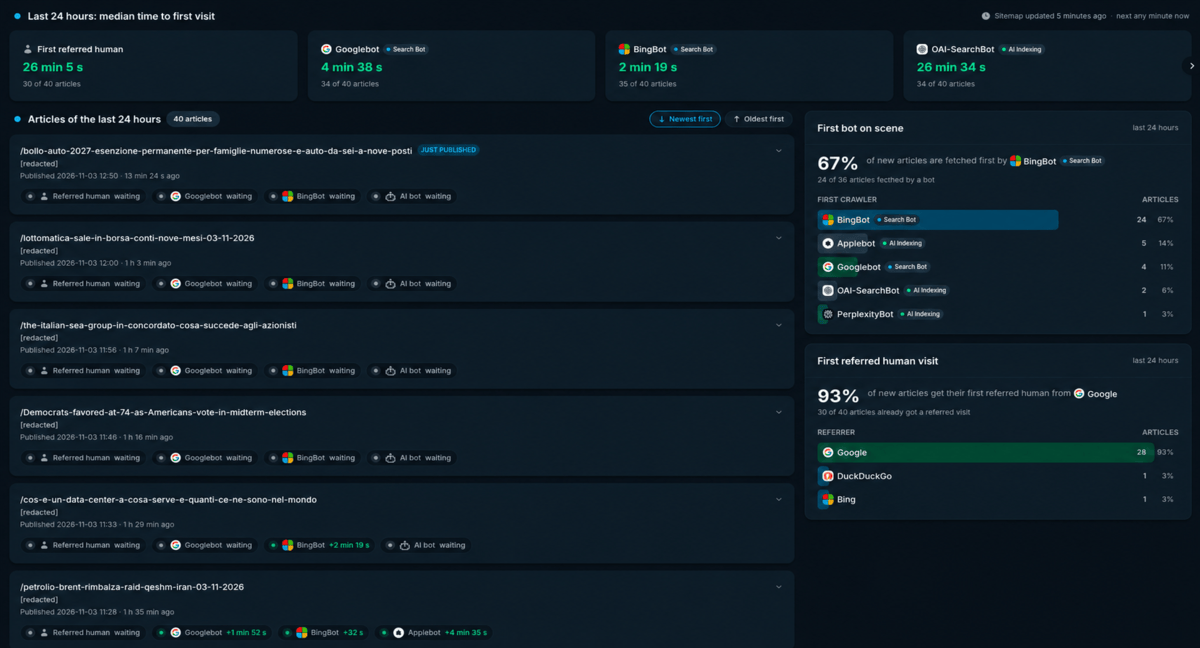
- Bingbot's median time to first crawl was 2 minutes and 32 seconds.
- Googlebot's median time to first crawl was 4 minutes and 57 seconds.
- Bingbot was the first tracked crawler on 26 of 38 articles that received a bot visit, representing 68%.
Bingbot was frequently reaching new articles before Googlebot.
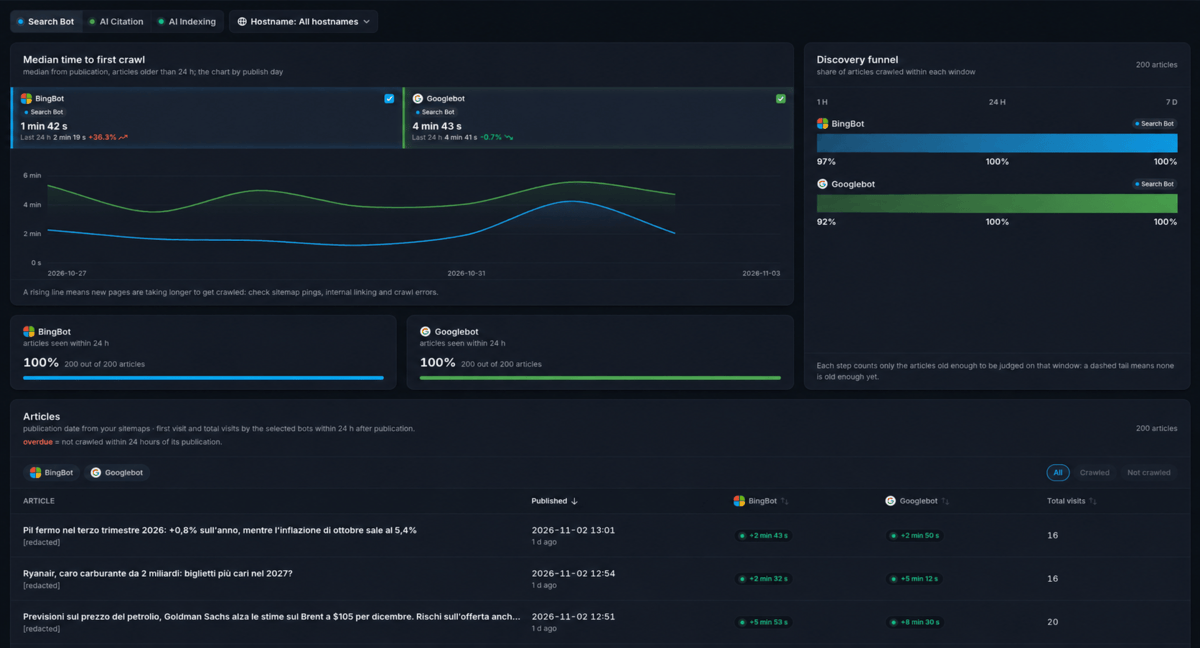
The longer-term trend showed a similar pattern. Across the displayed seven-day reporting period, Bingbot had a median first-crawl time of 1 minute and 40 seconds, compared with 4 minutes and 42 seconds for Googlebot.
However, the difference was less dramatic when looking at overall coverage.
Among 197 tracked articles in the seven-day report, 97% were crawled by Bingbot within one hour, compared with 92% for Googlebot. Both reached 100% within 24 hours.
In other words, both crawlers were reaching the publisher's articles relatively quickly. Bingbot simply tended to arrive first.
But Which Search Engine Brought the First Reader?
Here the picture changed.
Among 32 articles that had received a referred human visit during the 24-hour reporting window, Google was the first recorded referral source for 30 articles, or 94%.
Bing and DuckDuckGo accounted for one article each.
This contrast highlights an important distinction: the crawler that arrives first is not necessarily the search engine that sends the first visitor.
First-crawl time, indexing, search visibility and human referrals are related, but they measure different stages of the process.
These findings describe one publisher during specific observation periods. They do not establish that Bingbot is universally faster than Googlebot, or that either crawler's speed caused a particular traffic outcome.
Introducing HoneyLog Discovery: See When Crawlers Reach Your Articles
HoneyLog's Discovery feature is designed to make the time between publication and the first observed crawler visit measurable.
It brings together two complementary views.
Real Time: Follow Every Article After Publication
The Real Time view provides a live list of recently published articles, using publication information from the site's sitemaps.
For each article, publishers can see how long it took individual crawlers to make their first recorded visit.
That includes search crawlers such as Googlebot and Bingbot, as well as relevant AI indexing crawlers.
Newly published articles can also be monitored while they are still waiting for their first visit.
At a glance, editorial, SEO and technical teams can answer questions such as:
- Has Googlebot visited our latest breaking news story?
- Which crawler reached it first?
- Are certain articles waiting unusually long?
- Did a referred human visitor arrive, and from which source?
Instead of digging through raw logs for individual URLs, teams can examine the first observed crawler activity directly alongside the article's publication time.
Trends: Understand Crawler Performance Over Time
The Trends view takes the same information and turns it into a historical performance report.
Publishers can compare the median time to first crawl across search engines, identify changes over time and examine what proportion of articles are reached within different time windows.
For example, what percentage of newly published articles does Googlebot crawl within one hour? How many remain uncrawled after 24 hours? Is crawl latency increasing compared with previous days?
These questions are particularly relevant for publishers releasing dozens or hundreds of articles every day.
A gradual increase in crawl latency might suggest an issue worth investigating before it becomes a larger operational problem.
What Should Publishers Do When Crawling Slows Down?
A slower first crawl does not automatically indicate an SEO problem. Different search engines follow their own crawling schedules, and the urgency of an article does not guarantee immediate crawling.
Nevertheless, unusual delays can be a reason to investigate several factors.
- Sitemap freshness.Make sure new articles are included promptly and that publication and modification timestamps are accurate. Google provides specific recommendations for news sitemaps.
- Internal linking.Check that important new articles are accessible through crawlable links from relevant pages, including the homepage and category pages.
- Crawler accessibility.Review robots.txt, HTTP response codes, canonicalization and indexing directives. A crawler that encounters errors or blocked content may be unable to process the article as intended.
- Search engine notifications.For participating search engines, protocols such as IndexNow can help notify them when content is added or updated. Notification is not a guarantee of indexing.
Most importantly, publishers should compare these signals over time rather than interpreting every individual delay as a problem.
From Publication to Crawler to Reader
Understanding how quickly search engines visit a new article is only one part of understanding content discovery.
But it is a measurable part that has historically been difficult for editorial and audience teams to monitor.
Real-time crawl visibility helps publishers identify delayed articles, compare crawler behavior and investigate technical problems using evidence from their own infrastructure.
It also provides context for the next question: after search engines visit your content, which platforms actually send readers back?
With HoneyLog Discovery, publishers can stop guessing when crawlers arrive and start measuring it, article by article.
Explore HoneyLog's Discovery features to see how quickly search engines reach your latest content.