

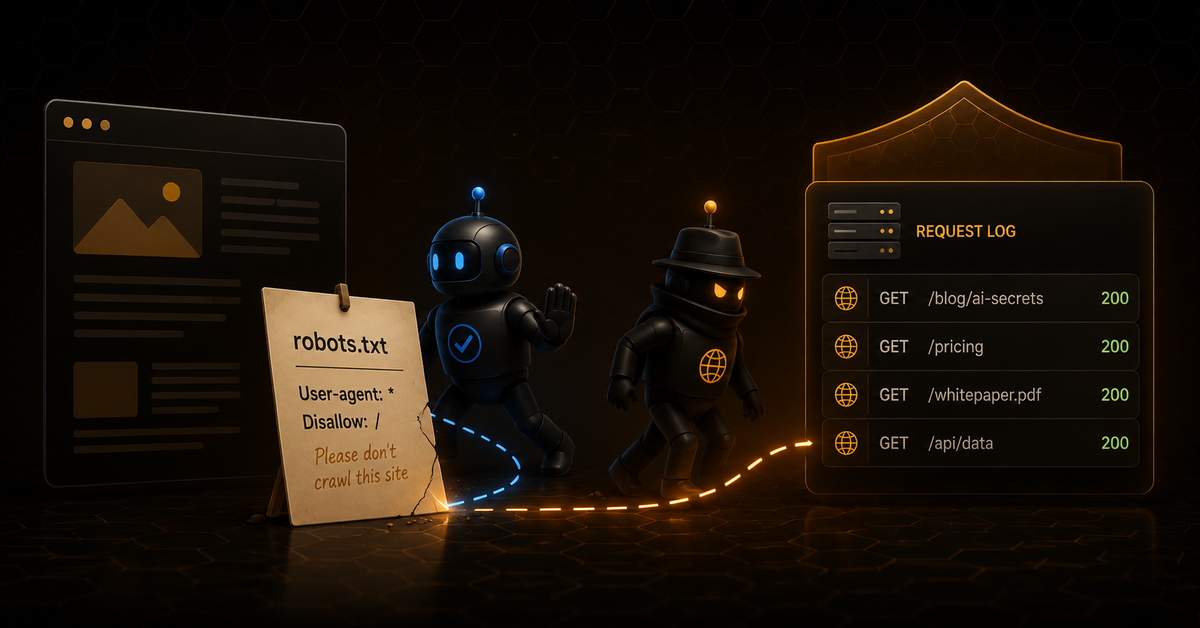
Why robots.txt Won't Protect Your Content from AI
Short answer: robots.txt is a polite request, not a wall. Well-behaved crawlers honor it; a large and growing share of AI crawlers don't. It can only name the bots you already know about, it's blind to disguised scrapers and user-driven AI agents, it can't stop your content reaching a model through someone else's dataset, and, most damning for anything you'd call "protection", it can't tell you whether any crawler actually obeyed it. Set it anyway, as a statement of intent. Just don't mistake a sign on the door for a lock.
If you added Disallow rules for the AI bots and crossed this off your list, this is the part nobody mentioned.
The myth
The belief is reasonable and almost universal: I disallowed GPTBot, ClaudeBot, Google-Extended and the rest in robots.txt, so my content is protected from AI. It feels like locking a door. It isn't, and understanding why is the difference between thinking you're protected and actually being so.
Here are the six reasons robots.txt falls short, ending with the one that matters most.
1. It's a request, not a wall
robots.txt was created in 1994, for a web of lightweight pages and a handful of predictable search crawlers. It works entirely on the honor system: the file asks compliant bots to stay out of certain paths. It has no enforcement mechanism whatsoever. Nothing in robots.txt blocks anything; it's a "please don't" sign, and it stops only the crawlers that have decided, voluntarily, to read and obey it. A crawler that ignores the sign walks straight in, because there's no door behind it.
2. A growing share of crawlers ignore it
This is the part that turns a weak protection into a leaky one. The share of bots that disregard robots.txt entirely is not just non-trivial, it's rising. By early 2025, industry estimates put it at roughly 13% of bots, up from around 3% a short time earlier, and by some 2026 assessments robots.txt is a signal that a large portion of AI traffic (by one estimate, close to half) simply ignores.
It's not only fringe scrapers, either. Investigations have documented well-known AI crawlers reaching content that robots.txt told them to leave alone; Perplexity's crawler was a widely reported example, examined by Cloudflare. Some crawlers, like ByteDance's Bytespider, honor the file inconsistently at best. "Compliant" is a spectrum, and it's trending the wrong way.
3. You can only block the bots you can name, and the list never stops growing
robots.txt blocks by user-agent: you have to know a crawler's name to disallow it. That makes your file a snapshot of the bots that existed the last time you updated it, and the roster changes constantly. In 2026 alone, Anthropic split ClaudeBot into a training crawler and separate retrieval agents; Meta's training crawlers scaled up to volumes rivaling the biggest; new user-triggered agents keep appearing. Each newcomer gets a free pass until you notice it and add a line. Your robots.txt is permanently one step behind the crawlers actually hitting you.
There's a subtler version of this too: some "blocks" don't even stop a fetch. Google-Extended, for instance, isn't a crawler you're turning away; it's a usage preference that governs whether already-crawled pages feed Gemini. You're not closing a door; you're filing a request about what happens after the content's been taken.
4. It's blind to disguised scrapers and AI agents
Because robots.txt keys on user-agent, anything that doesn't identify itself honestly sails past. A scraper can spoof an ordinary browser user-agent and become invisible to the file entirely. And the fastest-growing category, AI agents acting on a user's behalf, often ignores robots.txt by design, because the companies running them treat a user-triggered fetch as a person browsing rather than a crawler indexing. Google has said as much about its user-triggered fetchers. The traffic robots.txt was built to govern is shrinking as a share of what's actually reaching your content.
5. Blocking the crawler doesn't stop the content
Even a perfectly maintained, perfectly obeyed robots.txt has a gap you can't close from your own file: third-party datasets. Your content can be collected by an open crawler like Common Crawl and then used to train models by AI companies whose own crawlers you blocked. You shut the front door on one company's bot, and your content reaches it anyway through a dataset you never had a rule for. The uncomfortable reality publishers are waking up to is that, once content is on the open web, true removal is close to impossible.
6. The one that matters most: it tells you nothing
Set the other five aside and this alone disqualifies robots.txt as protection: it gives you zero feedback. You write your rules and you never find out what happened. Did the crawlers honor them? Which ones ignored them? What's still getting through? robots.txt is write-only; you're protected purely on faith, with no way to check whether the faith is warranted.
Real protection has a feedback loop. You enforce something, then you verify it's working. robots.txt has no second half. The only place the answer exists is your server logs, where every request (obedient or not, honest or disguised) is actually recorded. Without reading them, "I added it to robots.txt" and "my content is protected" are two completely different statements you have no way of connecting.
So is robots.txt useless?
No, and it's worth being fair about this. robots.txt is a necessary signal. It's the standard, machine-readable way to state your preferences; the major crawlers that do comply read it; and it's the foundation for supported opt-out tokens. Setting it clearly establishes, on the record, that you did not grant open access, which can matter normatively and legally. You should absolutely maintain one.
The error isn't using robots.txt. The error is mistaking a statement of intent for a mechanism of protection. It declares the rule. It doesn't enforce it, and it doesn't tell you if anyone followed it.
The hidden cost of leaning on it as a blunt instrument
There's a final twist. Because robots.txt is all-or-nothing per crawler, publishers tend to use it bluntly, disallowing everything AI and hoping for the best. But that can cut off the crawlers that send you readers along with the ones that just extract. AI referral traffic has grown sharply, by some reports roughly tenfold over 2025, and early-2026 research found publishers that blocked AI crawlers via robots.txt saw a meaningful drop in monthly visits with no matching drop in AI citations. The researchers themselves caution that's correlation, not proof of causation, but it captures a real bind: used bluntly, robots.txt can simultaneously fail to protect you and cost you traffic. (We unpack how to decide crawler by crawler in block, negotiate, or monetize.)
What actually protects, and verifies
If robots.txt is the politeness layer, real control has two more layers it can't provide:
Enforcement, at the edge. A firewall or WAF rule is evaluated before robots.txt is ever consulted, and it actually stops a request rather than asking nicely. That’s where a hard block lives. (See HoneyLog vs. Cloudflare for how edge blocking fits the picture.)
Verification, from your logs. Enforcement without measurement is the same faith problem in a different place; you still don’t know what’s getting through. Reading your server logs is the only way to confirm what your rules, polite or enforced, are actually doing. That’s the gap HoneyLog fills: it turns your logs into a continuous, independent view of every AI bot reaching your content, so “protected” becomes something you can verify instead of assume.
robots.txt declares the rule. Enforcement gives it teeth. Measurement tells you if any of it worked. You need all three, but you have only the first.
Frequently asked questions
Does robots.txt block AI crawlers?
Not technically. It requests that compliant crawlers stay away from certain paths, but it has no power to stop one that chooses to ignore it. It's a signal, not a barrier.
Do AI companies respect robots.txt?
Some honor it for some of their crawlers; many don't, and the share of bots ignoring it is rising. User-triggered AI agents frequently ignore it by design, treating their fetches as user activity rather than crawling.
If I block GPTBot, is my content safe from that company's models?
Not necessarily. Your content can still reach models through third-party datasets you haven't blocked, and Naming one crawler does nothing about the new ones that appear after you set the rule.
How do I actually stop AI crawlers?
With enforcement that has teeth, such as edge or firewall rules that block requests before robots.txt is read, paired with measurement of your server logs to verify it's working. robots.txt is a useful signal alongside those, not a substitute for them.
Should I still use robots.txt?
Yes. Maintain it as a clear statement of intent and to drive supported opt-out tokens. Just don't treat it as protection, and don't assume it's working without checking your logs.
Related reading:
Last updated: June 2026. The crawler landscape and the standards around it are shifting fast; we keep this piece current.