AI Visibility vs. AI Traffic Analytics: Two Halves of a Problem
Short answer: These are two different categories that get confused constantly.
AI visibility tools, like Profound or Peec, measure the output side: how your content shows up inside AI answers, whether you're cited, how often, and against which competitors.
AI traffic analytics, like HoneyLog, measure the input side: what AI systems are taking from you at the server level, which crawlers, what content, and how much. One tells you whether the AI is recommending you, while the other tells you whether it's taking from you.
They're complementary, not competing, and most publishers need both.
If you've been trying to figure out whether an AI-visibility tool covers what HoneyLog does (or vice versa), this is the map.
Why the confusion exists
"AI analytics" has quietly come to mean two completely different things, and the tools in each category don't always make the distinction obvious. Both talk about AI, both talk about your content, and both promise insight into how AI relates to your site. So buyers assume they're alternatives and try to choose between them, when in fact they sit at opposite ends of the same pipeline and answer questions the other can't.
The cleanest way to see it is to follow your content through the AI economy.
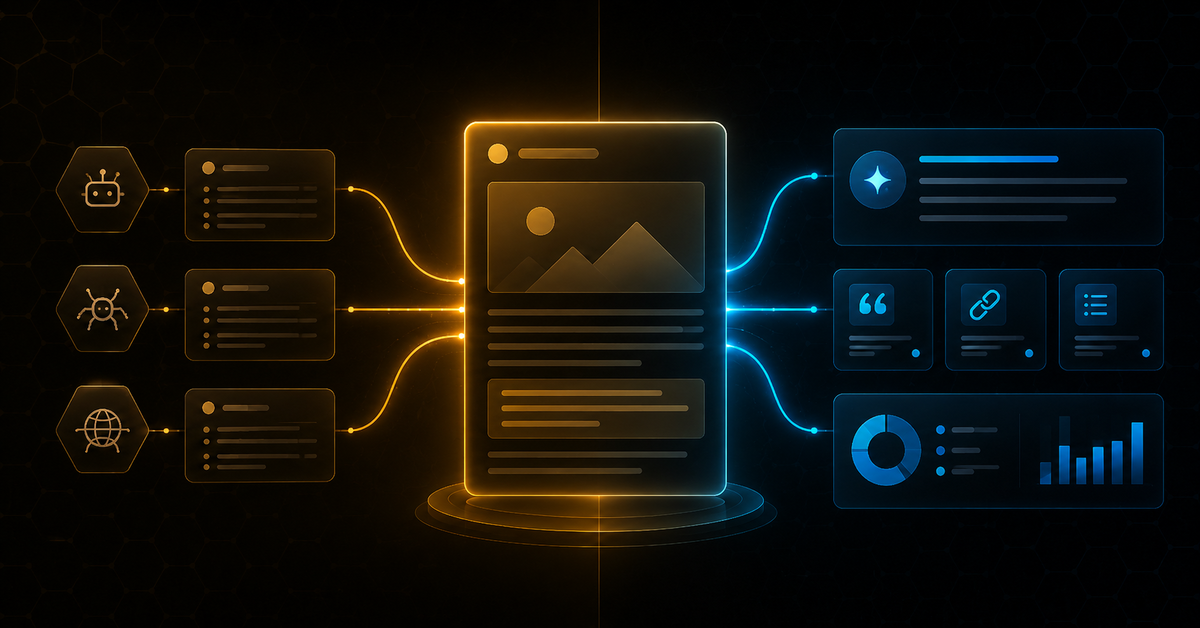
The AI content loop: input and output
Your content moves through AI in two stages:
- Input (it gets taken). AI systems crawl, scrape, and fetch your pages to train models and to retrieve content for live answers. This is your content going in.
- Output (it maybe shows up). When someone asks an AI a question, your content may or may not surface in the answer, whether it is cited, summarized, or not mentioned at all. This is your content coming out the other side, in front of a user.
Two different tool categories measure these two stages. Measure only one and you're seeing half of your relationship with AI.
Category 1: AI visibility (AEO / GEO)
AI visibility tools measure the output side, focusing on how your brand and content appear inside AI-generated answers. This is the category often labeled Answer Engine Optimization (AEO) or Generative Engine Optimization (GEO), and it exists because a huge and growing share of people now get answers from AI assistants rather than clicking blue links. If the AI doesn't mention you, you're invisible to those users.
These tools typically track:
- Citations: when and where AI engines reference you in answers.
- Share of voice: how often you appear versus competitors for the prompts that matter.
- Sentiment: whether the AI represents you positively, neutrally, or negatively.
- Prompt coverage: which user questions surface you, and which don't.
They work largely by querying the AI engines themselves, running prompts across ChatGPT, Gemini, Perplexity, Copilot, and others, and reporting how you show up. The primary buyer is marketing, SEO, or brand: someone whose job is to get found and recommended in AI answers. It's a legitimate, fast-growing discipline, and tools like Profound (which helped define the AEO category) and Peec are built squarely for it.
What this category doesn't tell you is what's happening before the answer: which AI systems are consuming your content in the first place, how much, and at what cost to you.
Category 2: AI traffic analytics
AI traffic analytics measure the input side, showing what AI systems are actually taking from your content. Instead of querying AI engines to see how you appear, these tools read your server logs to see who's reaching your content at the origin, specifically which crawlers, scrapers, and agents, against which pages, in what volume, trending which way.
This category answers a different set of questions:
- Who is consuming your content: training crawlers, search crawlers, scrapers, and agents.
- What they're taking: which sections and articles, and how heavily.
- How much, and trending how: the scale of extraction over time.
- What it's worth: the evidence base for whether to block, charge, negotiate, or allow.
The primary buyer here is revenue, rights, or technical: someone responsible for protecting and monetizing the content, or for the infrastructure it runs on. This is where HoneyLog sits. It turns your logs into a continuous, independent view of every AI bot reaching your content. (For why conventional analytics can't see this at all, see the AI traffic your analytics can't see.)
The clean distinction
| AI visibility (AEO / GEO) | AI traffic analytics | |
|---|---|---|
| Measures | The output side: how you appear in AI answers | The input side: what AI takes from your content |
| Core question | "Is the AI recommending us?" | "Is the AI taking from us? Who, what, and how much?" |
| Typical signals | Citations, share of voice, sentiment, prompt coverage | Crawler, scraper, or agent requests; content consumed; volume; trend |
| Data source | Querying AI engines (often plus a page script) | Your server logs, at the origin |
| Primary buyer | Marketing, SEO, brand | Revenue, rights, technical or infrastructure |
| Example tools | Profound, Peec | HoneyLog |
| Best for | Getting found and recommended in AI answers | Deciding whether to block, charge, negotiate, or allow |
"But don't some visibility tools track crawlers too?"
A fair question, because a few do. Some AI-visibility platforms add a lightweight script to your pages to note when AI crawlers visit, serving as context for their citation data. Two things make that different from AI traffic analytics.
First, the method. A page script is client-side, so it inherits the same blind spot as ordinary analytics. It can miss bots that don't execute it, and it depends on a tag rather than the complete, unavoidable record in your server logs. Traffic analytics read the origin, where every request lands regardless.
Second, the orientation. Even when a visibility tool notes crawler visits, it does so in service of a brand question: how to improve your AI citations. It isn't built to support a rights and revenue question: what's being extracted, what it's worth, and what to do about it. This is exactly the gap sophisticated publishers have run into. Some found the visibility tools too brand-focused for their needs and wanted to know which of their pages were feeding the models in the first place, to the point of building their own tooling. Different question, different tool.
Which do you need?
It depends on your goal, and increasingly, it's both.
- If your priority is being found (appearing and ranking well inside AI answers), you want AI visibility. It's the evolution of SEO for a world where the answer often replaces the click.
- If your priority is control and monetization (understanding and acting on what AI takes from you), you want AI traffic analytics. It's the foundation for any block, charge, or licensing decision.
- If you care about both, as most publishers do, you need both, because each is blind to the other's half.
Here's why measuring both beats measuring either. Suppose your visibility tool shows you're rarely cited in AI answers. That's useful, but on its own you don't know whether it's because your content isn't being ingested at all, or because it's being ingested heavily and just not credited. Traffic analytics answers that, and the two scenarios call for completely different responses. Or the reverse: you're cited often, which is great, but you don't know which crawlers drive that value, so you can't tell which ones are worth keeping when you set policy. Traffic analytics tells you which to allow. The two datasets contextualize each other. Together they describe both what you give to the AI economy and what you get back.
Where HoneyLog fits
HoneyLog is the input-side half of that picture. It reads your server logs to show exactly what AI systems are taking from your content, independently, continuously, and regardless of your CDN, so you can make informed decisions about access, pricing, and licensing. It doesn't compete with your AI-visibility tool; it answers the question your visibility tool can't. Run them side by side and you finally see the whole loop: what you're giving, and what you're getting. (For what to do with the input-side picture, see block, negotiate, or monetize.)
Frequently asked questions
What's the difference between AI visibility and AI traffic analytics?
AI visibility measures how your content appears in AI answers: citations, share of voice, sentiment. AI traffic analytics measures what AI takes from your content at the server level: which crawlers, what pages, how much. Output versus input.
Is HoneyLog an alternative to Profound?
No, they're different categories. Profound and similar tools measure how you show up inside AI answers (the output side). HoneyLog measures what AI systems consume from your content (the input side). They're complementary, and many publishers use both.
What is Answer Engine Optimization (AEO)?
AEO is the practice of optimizing your content to appear and be cited in AI-generated answers, as a growing share of people get information from AI assistants instead of search results. It's the discipline AI-visibility tools support.
Do I need both an AI visibility tool and AI traffic analytics?
Usually, if you care about both being recommended by AI and protecting or monetizing your content. Each measures a different half of your relationship with AI and is blind to the other.
Don't AI visibility tools already track AI crawlers?
Some note crawler visits via a page script, as context for citation data. That's client-side and brand-oriented, which differs from server-level traffic analytics built to see all access independently and to support rights and revenue decisions.
Related reading:
Last updated: June 2026. The AI visibility and analytics categories are both evolving fast; we keep this map current.